Blockchain Ecosystem
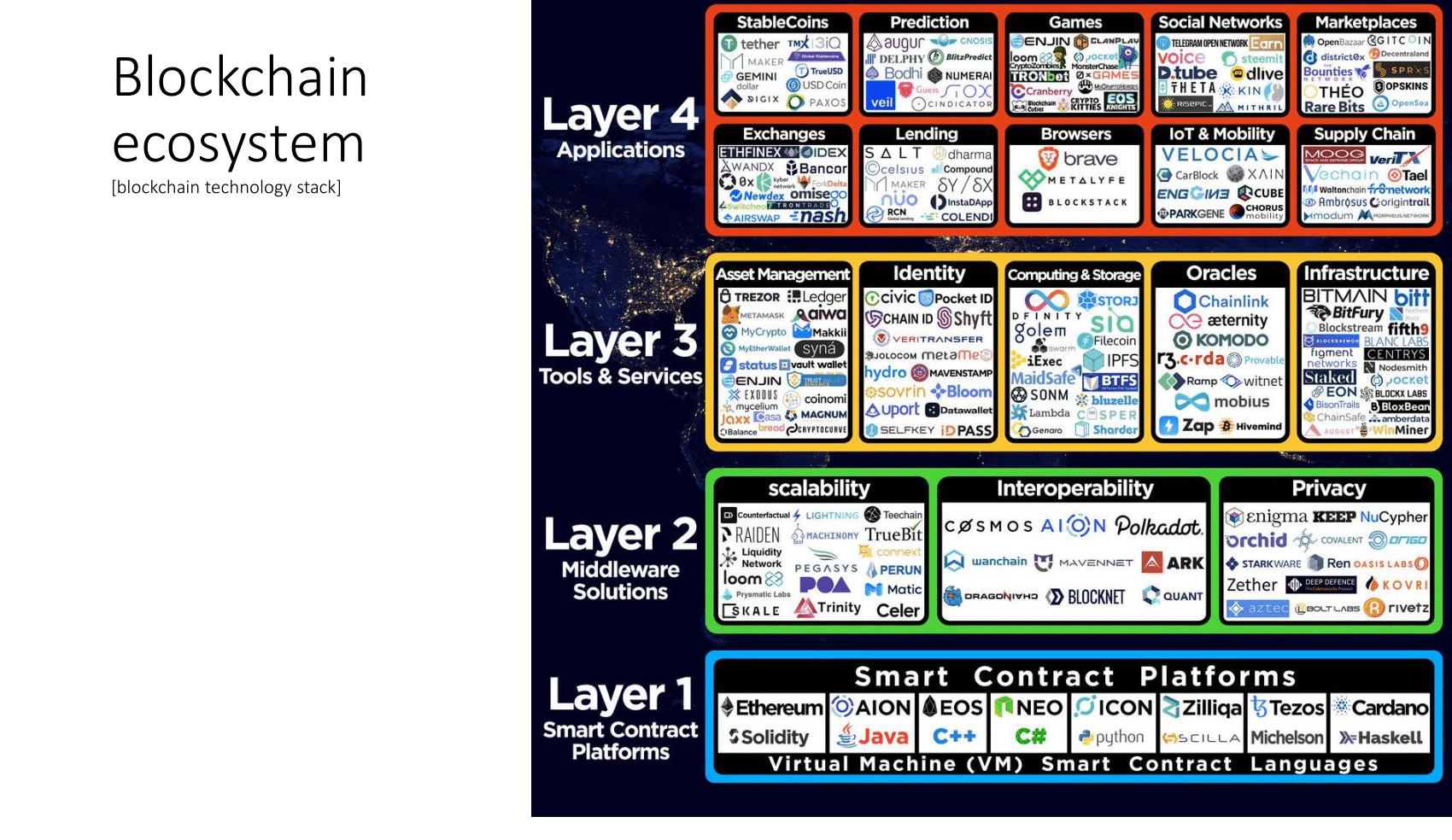
Layer 1 - Smart Contracts platforms
Ethereum Solidity
Ethereum was proposed in late 2013 by Vitalik Buterin, a cryptocurrency researcher and programmer.The Ethereum Virtual Machine (EVM) is the runtime environment for smart contracts in Ethereum. It is a 256-bit register stack, designed to run the same code exactly as intended. It is the fundamental consensus mechanism for Ethereum. Ethereum’s smart contracts are based on different computer languages, which developers use to program their own functionalities. Smart contracts are high-level programming abstractions that are compiled down to EVM bytecode and deployed to the Ethereum blockchain for execution. They can be written in Solidity (a language library with similarities to C and JavaScript), Serpent (similar to Python, but deprecated), LLL (a low-level Lisp-like language), and Mutan (Go-based, but deprecated). There is also a research-oriented language under development called Vyper (a strongly-typed Python-derived decidable language).
AION
Aion is a smart contract platform that enables routing of transactions and messages between different blockchains via its innovative “bridging” protocols. Aion is a multi-tier network comprised of the following components:
Bridges
Connecting Networks
Interchain transactions
Participating Networks
Aion’s bridges will make it possible to transact across multiple blockchains (interchain transactions) via the AION blockchain ecosystem. Interchain transactions are executed via bridges and connecting networks. Connecting Networks represent the protocols via which all public and private blockchains can intercommunicate with AION’s blockchain ecosystem. Participating Networks are networks that have fulfilled a special set of requirements to become part of AION’s blockchain ecosystem. Participating Networks have to support broadcasting of atomic transactions, and implement lock-time that will enable them to freeze up transactions that enter a state of “Oh Hold”.
The Aion Virtual Machine (AVM) enables the execution of smart contracts. AVM is a JVM implementation that is designed to execute chain logic. The Aion language is the scripting language used to program smart contracts in the AVM. Currently, Aion’s kernel runs on Java, so developers have to use languages like Python or Groovy to code smart contracts on Aion’s blockchain. However, the platform will eventually rely on the Aion language for scripting smart contracts.
Aion-1 is Aion’s standalone platform that permits the execution of smart contracts created on other blockchains. Right now, Aion relies on Ethereum’s EVM, yet eventually Aion-1 will be activated and enable developers to run their Ethereum based smart contracts and DApps much cheaper and faster than on the EVM.
Additional links:
https://developer.theoan.com/docs/custom-kits/ https://github.com/aionnetwork/aion
EOS
EOS is increasingly becoming one of the most popular smart contract platforms. The platform has captured the attention of the crypto community due to a myriad of reasons, namely that transactions on the platform require near zero fees, and the platform’s capability to handle millions of transactions per second.
Smart contracts are programmed using C++, which boosts programming flexibility. EOS smart contracts are implemented onto the blockchain in the form of pre-compiled Web Assembly (WASM), which promotes faster execution of contracts when compared to Ethereum based smart contracts. WASM is compiled with C/C++ via means of clang and LLVM. Developers have to have knowledge of C/C++ in order to be able to code smart contracts on EOS’s blockchain. Even though C can be used to create contracts, it is highly recommended to use the EOS.IO C++ API, which strengthens contract’s safety and renders its code easily readable. EOS utilizes the delegated proof of stake (dPoS) consensus mechanism, which acts with partial evaluation and parallel execution to offer a smart contract platform with high levels of scalability and near zero transaction fees.
EOSIO-based blockchains use delegated proof of stake (DPoS) to elect the active producers who will be authorized to sign valid blocks in the network. However, this is only one half of the EOSIO consensus process. The other half is involved in the actual process of confirming each block until it becomes final (irreversible), which is performed in an asynchronous byzantine fault tolerant (aBFT) way. Therefore, there are two layers involved in the EOSIO consensus model:
Layer 1 - The Native Consensus Model (aBFT).
Layer 2 - Delegated Proof of Stake (DPoS).
Additional links:
https://github.com/EOSIO/eosio.contracts
NEO
NEO is a smart contract platform that features efficient and low fee smart contracts. Smart contracts can be coded using a myriad of programming languages including C#, F#, Java, Python, VB.Net, and Kotlin. NEO offers plug-ins and compilers for all of these languages. In the future, support for JS, Go language, C, and C++ will be implemented.
NEO’s smart contracts are executed via the lightweight NEO Virtual Machine (NeoVM). Smart contract execution via NeoVM consumes minimal resources. Static compilation of smart contracts and caching of hotspot smart contracts can be considerably enhanced via the real-time compiler JIT. Currently, NEO’s blockchain features Smart Contract 2.0 which boasts support for complex data structures and arrays. Also, Smart Contract 2.0 provides a scalable approach via dynamic partitioning and high concurrency, in combination with a low coupling design. The low coupling procedure of smart contracts is executed in NeoVM and interacts with off-chain systems via an interactive service layer. As such, most of the smart contract function upgrades can be achieved via the special API of the interactive service layer. Classes used in the dBFT consensus algorithm.
Additional Links:
ICON
ICON Network is a general purpose blockchain protocol based on the native cryptocurrency ICX that can run smart contracts, adopt the BFT-DPoS (Delegated Proof-of-Stake) consensus protocol, and use an economic-governance protocol called DPoC (Delegated Proof-of-Contribution). The ICON Network is powered by a proprietary blockchain engine called ‘loopchain’ and has the ability to handle hundreds of transactions per second. The ICON project was started to ensure the integrity and transparency of data shared between institutions and companies, and to move mutual assets on heterogeneous blockchains without a centralized organization. In the long term, ICON Network will be an interchain that connects multiple blockchains based on BTP technology.
Additional links:
ZILLIQA
Scilla short for Smart Contract Intermediate-Level LAnguage is an intermediate-level smart contract language being developed for Zilliqa. Scilla has been designed as a principled language with smart contract safety in mind.
Scilla imposes a structure on smart contracts that will make applications less vulnerable to attacks by eliminating certain known vulnerabilities directly at the language-level. Furthermore, the principled structure of Scilla will make applications inherently more secure and amenable to formal verification.
Zilliqa - the underlying blockchain platform on which Scilla contracts are run, has been designed to be scalable. It employs the idea of sharding to validate transactions in parallel. Zilliqa has an intrinsic token named Zilling, ZIL for short that are required to run smart contracts on Zilliqa.
Additional Links:
https://github.com/Zilliqa/scilla
TEZOS
The Tezos blockchain project was founded by a US company, Dynamic Ledger Solutions, as an alternative to Ethereum. Tezos was created as a new-generation decentralized platform with unique network update and smart contract functionality. It’s also a platform for developing decentralized applications (DApps).
The Tezos team introduced on-chain governance where token holders are authorized to govern blockchain development. In addition, the security of smart contracts is ensured with the Michelson programming language, which supports formal verification. Unlike other popular platforms like Bitcoin and Ethereum, which use Proof of Work algorithms, Tezos benefits from Proof of Stake to achieve distributed consensus.It was originally published on https://www.apriorit.com/
Additional Links:
https://tezos.com/get-starte https://gitlab.com/tezos/tezos
CARDANO
Cardano is a proposed platform for smart contracts development, built on a proof-of-stake blockchain. Its goal is solving scalability while balancing the need for regulation with the privacy and decentralization of blockchain technology. This vision is ambitious and promising, but much of Cardano’s platform is still undeveloped and progress is moving slowly.
Cardano is also written in a security-focused programming language: Haskell. Haskell features strong static typing and is a purely functional programming language. That means that Haskell’s components only rely on the arguments fed to them and they disregard changes to overall state. Functional programs are easier to secure and more walled off from outside influence.
Additinal Links:
https://www.skalex.io/cardano-worth-the-hype/ https://github.com/input-output-hk https://roadmap.cardano.org/en/goguen/
Layer 2 - Middleware Solutions
SCALABILITY
Conterfactual
Counterfactual — through generalized state channels — solves these problems by moving processes off the blockchain, while still giving processes the benefits of blockchain. Counterfactual transactions are cheap and fast, yet still trustless and final.( https://medium.com/coinmonks/understanding-counterfactual-and-the-evolution-of-payment-channels-and-state-channels-9e939d7c6f34)
Lightning
The Lightning Network is a decentralized system for instant, high-volume micropayments that removes the risk of delegating custody of funds to trusted third parties. Additional Links: https://lightning.network/lightning-network-summary.pdf
Teechain
Raiden
The Raiden Network is an off-chain scaling solution, enabling near-instant, low-fee and scalable payments. It’s complementary to the Ethereum blockchain and works with any ERC20 compatible token. The Raiden project is work in progress. Its goal is to research state channel technology, define protocols and develop reference implementations. (https://raiden.network/#:~:text=The%20Raiden%20Network%20is%20an,project%20is%20work%20in%20progress.)
TrueBit
Truebit is a blockchain enhancement which enables smart contracts to securely perform complex computations in standard programming languages. (https://people.cs.uchicago.edu/~teutsch/papers/truebit.pdf)
Machinomy
Machinomy is a micropayments SDK for Ethereum platform. State channels is a design pattern for instant blockchain transactions. It moves most of the transactions off-chain. As transactions do not touch the blockchain, fees and waiting times are eliminated, in a secure way.
It brings a possibility of instant transactions and low value payments. Paid media consumption, like unobtrusive micropayments for video streaming is one application. Another one is tipping for live performers. One could also think about blockchain games, and machine-to-machine transactions. (https://machinomy.com/)
Liquidity Network is a blockchain based payment hub platform offers zero-fee and instant transfers.
Connext
Connext is an infrastructure layer on top of Ethereum that lets Ethereum wallets, applications and protocols do instant, high volume transactions with arbitrarily complex conditions for settlement. Projects that integrate Connext can enable users to batch up Ethereum interactions to get more transaction throughput per block. (https://docs.connext.network/en/latest/)
Loom
Loom Protocol powers Basechain, an interoperable DPoS blockchain that is live in production, EVM-compatible, audited, and battle-tested. (https://github.com/loomnetwork/loomchain)
Trinity
Trinity is a universal off-chain scaling solution, which aims to achieve real-time payments with low transaction fees, scalability and privacy protection for mainchain assets. Using state channel technology, Trinity will significantly increase the transaction throughput of underlying chains as well as the assets on smart contracts. TNC cross-chain converter facilitates the data and value flow between multiple chains. Trinity will be a fully autonomous and decentralized performance-enhancing network for the entire ecosystem and provides all-round support to Dapps on bottom layer chains in the future.
Perun
Perun’s Generalized State Channels Framework uses a set of interconnected smart contracts to define the on-chain logic for channel deposits, disputes, settlements and withdrawals (https://github.com/perun-network/contracts-eth)
Matic
Matic Network brings massive scale to Ethereum using an adapted version of Plasma with PoS based side chains. (https://matic.network/)
Celer
Celer Network is a leading layer-2 scaling platform that enables fast, easy and secure off-chain transactions for not only payment transactions, but also generalized off-chain smart contract. It enables everyone to quickly build, operate, and use highly scalable decentralized applications through innovations in off-chain scaling techniques and incentive-aligned cryptoeconomics. (https://www.celer.network/)
Pegasys
Prysmatic Labs
INTEROPERABILITY
Cosmos
Cosmos is a decentralized network of independent parallel blockchains, each powered by BFT consensus algorithms like Tendermint consensus. The end goal is to create an Internet of Blockchains, a network of blockchains able to communicate with each other in a decentralized way. With Cosmos, blockchains can maintain sovereignty, process transactions quickly and communicate with other blockchains in the ecosystem, making it optimal for a variety of use cases.
Aion
Aion is a smart contract platform that enables routing of transactions and messages between different blockchains via its innovative “bridging” protocols.
Polkadot
Polkadot is a “heterogeneous multi-chain technology.” Essentially, it is (or rather intends to be) a blockchain that connects many different blockchains. It is designed to solve some of the major problems that are preventing blockchain technology from reaching large-scale, real-world application.
Wanchain
Wanchain is a public blockchain with support for the development of smart contracts using Solidity. Wanchain supports ring signature based private transactions and decentralized cross chain functionality.
Wanchain’s Storeman node system uniquely combines secure multiparty computation, atomic swaps, threshold secret sharing, and decentralized account management to implement a decentralized cross chain solution.
A developer can write smart contracts, build a DAPP or issue a fungible/non-fungible token on wanchain.
Through Wanchain’s cross chain features, it is possible for any blockchain’s assets to be connected with and circulate on Wanchain. This includes assets from public, private, as well as consortium chains.
Mavennet
ARK
Ark describes itself as an open source framework to create blockchains with one click. The ARK Platform provides a so called“Smart Bridge”. The Smart Bridge is a sidechains in the Ark blockchain. Instead of supporting different blockchains by implementing sidechains compatible with each other blockchain, Ark only provides a generic protocol, thus leaving it up to the blockchain to implement it. However, this means that either a blockchain needs to be created by using the tools from Ark or it has to change its implementation to be able to send data to the Ark blockchain. A second interoperability feature is their planned integration of cryptocurrency exchanges (e.g., Shapeshift) to convert between different cryptocurrencies automatically, thus additionally implementing a notary scheme
Blocknet
Blocknet is a blockchain interoperability protocol that enables communication, interaction, and exchange between different public and private blockchains, as well as connect to external off-chain APIs and services via oracles. This exponentially increases the development capabilities and enables a new generation of mature blockchains and services.
Blocknet is an open sourced, self-funded, and self-governed project with contributors around the world building an open and collaborative ecosystem.
Quant
The breakthrough was achieved by integrating Quant Network’s Overledger technology (the world’s only DLT operating system that allows interoperability) into the SIAchain private blockchain infrastructure leveraging on 580 European network nodes within SIAnet (the fiber optic network with high-speed and low-latency stretching over 208,000 kilometres).
This integration provides the ability to bridge permissioned blockchain instances between SIAchain and other external networks – which could not be previously connected – in order to have cross-platform applications and services covering for example notarisation, payments and KYC.
The development of the solution began in mid-2019 and a full program of testing has been executed on SIAchain, R3 Corda and private Ethereum platforms.
Additional Links: https://www.quant.network/news-room/quant-network-and-sia-successfully-tested-blockchain-interoperability/
PRIVACY
Enigma
Enigma is a decentralized computation platform with guaranteed privacy. Our goal is to enable developers to build ’privacy by design’, end-to-end decentralized applications, without a trusted third party. (https://web.media.mit.edu/~guyzys/data/enigma_full.pdf)
Keep
NuCypher
NuCypher is a privacy layer for blockchains. It enables end-to-end encrypted data sharing on public blockchains (e.g. Ethereum) and decentralized storage solutions (e.g. IPFS). NuCypher allows users to conditionally grant and revoke access to data with multiple users at a time. NuCypher provides the backbone for applications that involve the transfer of sensitive data but also want to leverage the trustless and censorship-resistant nature of public blockchains. (https://www.nucypher.com/)
Orchid
The Orchid network enables a decentralized virtual private network (VPN), allowing users to buy bandwidth from a global pool of service providers.
To do this, Orchid uses an ERC-20 utility token called OXT, a new VPN protocol for token-incentivized bandwidth proxying, and smart-contracts with algorithmic advertising and payment functions. Orchid’s users connect to bandwidth sellers using a provider directory, and they pay using probabilistic nanopayments so Ethereum transaction fees on packets are acceptably low (https://www.orchid.com/)
Covalent
Covalent is built by a smart team of financial analysts, data scientists, blockchain and database engineers passionate about improving and scaling blockchain technologies. Covalent is funded by leading venture investors, with over a decade of expertise building and scaling technology companies. The company is headquartered in Vancouver, BC.
Covalent has built our own proprietary technology that is connected to 7 different blockchain development platforms that scrape the blockchain platforms for traction and adoption data. These platforms have a combined total of over 500 million smart contract transactions. This technology in combination with our own research methodology, has positioned Covalent to be early frontrunners in the blockchain/crypto business information industry. (https://www.covalenthq.com/)
ONGO
Starkware
STARKs (Scalable Transparent ARguments of Knowledge) are a family of proof-systems characterized by scalability and transparency. Scalability - via quasilinear proving time and poly-logarithmic verification time, and transparency - meaning all verifier-side messages are public random coins (requiring no trusted setup).
This project implements a STARK protocol as a non-interactive protocol between a prover and a verifier. The prover sends a proof in order to convince the verifier that a certain statement is true. Usually the proven statement indicates that a desired computation on some input was executed correctly. The verifier reads the given proof in order to test the integrity of the proven statement. To that end, the Fiat-Shamir heuristic is employed in order to turn what can be described as an interactive communication to a non-interactive protocol.
Zether
we propose an efficient, fully-decentralized confidential payment mechanism in the account-based model called Zether, which does not require any changes to the design of the underlying smart contract platform like Ethereum. We describe Zether as a smart contract that can be executed either individually or by other smart contracts to exchange confidential amounts of a token, denoted by ZTH. The techniques used in Zether can apply to other account-based crypto-currencies, completely independent of their consensus mechanisms. (https://crypto.stanford.edu/~buenz/papers/zether.pdf)
Ren
A secure network of virtual computers that powers interoperability for decentralized applications, enabling cross-chain lending, exchanges, collateralization & more. (https://renproject.io/renvm)
Oasis Labs
At Oasis Labs, our goal is to build tools that not only make it easier to share and control data, but also more secure.
That’s why our team of privacy experts and security engineers are turning some of academia’s most compelling privacy research into production ready features of our tooling. (https://www.oasislabs.com/)
Aztec
The new internet of money is secured by openness, but at a high price — all your counterparties know your entire financial history. Aztec is the ultimate security shield for the internet of money, protecting user and business data on Web3.0. (https://www.aztecprotocol.com/)
Bolt Labs
zkChannels (formerly BOLT) eliminates lag time and high transaction fees — while offering strong privacy protections — so you can use Zcash, Bitcoin, Tezos and other digital currencies for everyday payments and purchases. (https://boltlabs.tech/)
Rivetz
Rivetz was founded in 2013 with the mission to “provide users with a simpler and safer experience” and presenting service providers with “a more valuable subscriber for blockchain, IoT and cloud.” The company has offices across the U.S. in New York, New York; Richmond, Massachusetts; and Santa Cruz, California. Rivetz also delivers a new paradigm of decentralized cybersecurity to simplify and enhance the digital user experience. With its combination of blockchain technology and the hardware-based trusted computing capabilities, Rivetz verifies the intent of every transaction. Using this capability, the firm intends to transform the internet with its device-centric global model so users can enjoy online products and services safely, without interruption. (https://aspioneer.com/rivetz-a-driving-force-for-decentralized-security/)
Deep Defence
Kovri
In order to understand Kovri, it’s important to know that there are two layers to blockchain privacy. The first, which Ring Signatures, RingCT, and Stealth Addresses attempt to protect, is validation privacy: the network can verify the transaction without exposing the personal/private details of the involved parties. The second is transmission privacy.
In order to understand transmission privacy, we need to briefly walk through how data transmission works on the Internet. Data transfer on the Internet, whether via a blockchain or other, fundamentally works in the same way: the data is originated and sent from a computer, known as the “client” node.¹⁰ The client node has a public address associated with it, which represents its location within the Internet, known as an IP address. Whether we realize it or not, the data sent and received online is always triggered by a command from the client node via an Internet browser, such as “send me to ESPN.com,” or “send this message to that e-mail address” or “send 3 BTC to Alice.” Based onTCP/IP, the communication protocol for the Internet, the sender’s command tells its client node what the intended destination node is supposed to be for the data.¹¹ Almost always, unless the client and destination nodes are on the same local network, the client node only knows the destination’s domain name, such as espn.com or an e-mail address. In other words, the sender doesn’t know the IP address of the receiver. As a result, the data travels through the Internet being forwarded from the client node through a pathway of nodes, known as “relay” nodes, looking for a DNS server that contains the domain name in its database and its associated IP address. (https://www.wavegp.com/media/blockchain-privacy#:~:text=In%20order%20to%20understand%20Kovri,details%20of%20the%20involved%20parties.)
Layer 3 - Tools and Services
Asset Management
Trezor
It is offline cryptocurrency wallet. (https://trezor.io/)
Ledger
It is offline cryptocurrency wallet. (https://www.ledger.com/)
MyEtherWallet
MyEtherWallet (our friends call us MEW) is a free, client-side interface helping you interact with the Ethereum blockchain. Our easy-to-use, open-source platform allows you to generate wallets, interact with smart contracts, and so much more. (https://www.myetherwallet.com/)
Metamask
It is a cryptocurrency wallet. https://metamask.io/
Aiwa
AIWA is a wallet and DApp interaction tool for Aion. (https://getaiwa.com/)
My Crypto
MyCrypto allows you to create, import, and manage all the wallets you’ll ever need. (https://beta.mycrypto.com/)
Makkii
Makkii is a mobile wallet for Aion that allows you to store AION coin. Users can create and recover existing AION wallets, send and receive AION coins, and look up transactions. (https://docs-aion.theoan.com/docs/makki)
Syna
Syna Desktop is an easy to use desktop application available on Windows, Mac and Linux. It incorporates all of the accessability features available in the Syna Mobile and Syna+ Chrome plugin. In addition to this, Syna Desktop includes full cold storage for Ledger and hardware wallets. (http://theoproject.io/syna/)
Status
Status is a secure messaging app, crypto wallet, and Web3 browser built with state of the art technology. (https://status.im/)
Vault Wallet
Bank level security with “Venmo” level usability. Level up your crypto experience with Vault Wallet (https://vaultwallet.io/)
Enjin
Blockchain wallet : Impenetrable, feature-packed, and convenient—built for traders, gamers, and developers. (https://enjin.io/wallet)
Trust Binance
Download Trust Wallet with Binance Coin (BNB) supports bitcoin and other crypto tokens & blockchain wallets Only you have control over your funds. Receive, Send, Store and exchange your cryptocurrency right in the mobile interface. (https://trustwallet.com/binance-coin-wallet/)
Exodus
Exodus Crypto Wallet Send, receive & exchange cryptocurrency with ease on the world’s leading Desktop, Mobile and Hardware crypto wallets. (https://www.exodus.io/)
Coinomi
Securely store, manage and exchange Bitcoin, Ethereum, and more than 1,770 other blockchain assets (https://www.coinomi.com/en/)
MyCelium
Mycelium Wallet is great for bitcoiners. We will make it useful for everybody. (https://wallet.mycelium.com/)
Magnum
Jaxx
Jaxx Liberty is available for Android, iOS, Mac OS X, Windows, Linux, and Google Chrome extension. It’s 100% free and is already trusted by hundreds of thousands of users around the world. Start your journey. (https://jaxx.io/?&__cf_chl_jschl_tk__=c1b423a8e1565edec86f220fc773ae8e4b80aa18-1600631718-0-AQkSehOyB4jr018d7SowEOD1T1DCF8WMo-JolU1-mnG1PcceUnJ6XXxDo4r9AJ6U9bxeBmlOde5wd4P9bAD4eiaNfjOwXxAfY0Dg3QrmLXxaCg1ccpgn0rjytS0wIRM_QCDIYUee4jcV_3c4L9kqZK5sx5bJVRyrk_Txa2tnWBFlo8WEZKHRRyrPLnLIxAPRrF4wC0mAB7e3BvxRn8Ny5eXcTCv9c8GUtS1QM0VjvDDeHyqiVzjdg4MP48JuD4Tai7DEiUxs3VzBVCE8crfnBAT6Wm29msPp0GsOkhkUAzUm24kTAeE7pKtk367xQ5I0VF1XcfCP0Ip7C-tRHsQTUxE)
Casa
Balance
https://www.balance.io/https://www.balance.io/
Bread
https://github.com/breadwallet
Cryptocurve
https://wallet.cryptocurve.network/account
Identity
Civic
Keep your verified identity private. Store and send digital currency safely. Protected by our $1M guarantee. (https://www.civic.com/)
Pocket ID
PocketID is a quick and seamless solution to jump start your blockchain application. It features from SSO (Single Sign-on) to tools for your user’s blockchain needs to built-in flows for handling wallet features such as balance and transactions. This guide will introduce you on how to begin building dApps (Decentralized Applications) with the help of PocketID. (https://pocketiddoc.readthedocs.io/en/latest/)
Chain ID
A list of EVM networks. Wallets and Web3 middleware providers should be able to use the appropriate Chain ID and Network ID to connect to the correct chain. (https://chainid.network/)
Shyft
Shyft Network is a public blockchain protocol designed to aggregate and embed trust and validation into data stored on public and private ecosystems, and permissioned and permissionless networks. By facilitating bridging across siloed datasets, Shyft allows for layering of context on top of data, ultimately turning raw data into meaningful information. (https://www.shyft.network/)
Veritransfer
VeriTransfer is the 1st known digital platform where individuals can responsibly ensure proper, legal and safe gun ownership and transfers. The app serves as a firearm intelligence toolkit that affords retailers and sellers with access to the necessary information to ensure user eligibility. Easy to use, the app puts the control in the hands of the user with access to their personal data limited solely to their purview and discretion over what information is made available in a firearm transfer or related transaction. (https://www.veritransfer.io/)
Jolocom
Jolocom build an open source protocol for people and organizations to create and interact with digital, self-sovereign identities. (https://jolocom.io/)
Metame
Your data is yours to own, use and monetize however you choose. We empower you to gain full control of your digital self, so you’re free to explore how your data can enrich your life. (https://metame.com/)
Hydro
All assets for Hydro including multimedia, white papers, social media, and smart contracts have been moved to the open source community at projecthydro.org (https://www.hydrogenplatform.com/hydro#)
Mavenstamp
Mavenstamp is an easy to use blockchain-based timestamping service designed to protect the integrity of your data by making it tamper-proof. Simple/ready to implement, integrate. (https://www.mavennet.com/solutions/mavenstamp/)
Sovrin
Personally manage your digital IDs online with the Sovrin Network – an open source project creating a global public utility for self-sovereign identity (https://sovrin.org/)
Bloom
Bloom is a blockchain solution for secure identity and credit scoring. Bloom gives consumers ownership over their identity and financial data. By decentralizing the way that information is shared between untrusted parties, the system reduces risk of identity theft and minimizes costs associated with customer onboarding, compliance and fraud prevention. https://bloom.co/
Uport
Datawallet
Datawallet’s mission is to enable every organization to become compliant with the CCPA, GDPR and other privacy regulations in the easiest way possible and to empower their consumers to be in charge of their data. Datawallet Consumer First Compliance is an easy-to-install, comprehensive, and flexible platform to manage a businesses’ every data privacy compliance needs. Consumers get a clean, clear, and 21st century user experience that makes it easy for them to understand how their data is managed and make informed decisions about the usage of their data. Datawallet turns compliance into a win-win, where consumers feel safe about their data and companies achieve compliance with ease. (https://datawallet.com/whats-a-datawallet/)
Selfkey
The SelfKey wallet is non-custodial, you are in full control of your data, documents and digital assets. (https://selfkey.org/)
ID Pass
ID PASS enables governments and humanitarian organizations to issue and verify a decentralized, private, trusted and recoverable form of identity to all population subsets, including citizens, residents and refugees. (https://www.idpass.org/#:~:text=ID%20PASS%20utilizes%20Decentralized%20IDs,shared%20and%20what%20is%20private.)
Computing Storage
Dfinity
The Internet Computer, thereby reinventing the Internet as a computer that hosts secure software with superpowers. The Internet Computer is a new technology stack that is unhackable, fast, scales to billions of users around the world, and supports a new kind of autonomous software that promises to reverse Big Tech’s monopolization of the internet.
DFINITY was founded in 2016 by Dominic Williams. (https://dfinity.org/foundation)
Storj
Storj is an S3-compatible platform and suite of decentralized applications that allows you to store data in a secure and decentralized manner (https://documentation.storj.io/)
Golem
Permissionless and anonymous decentralized networks like Golem Network have to provide countermeasures against Sybil attacks, for instance. One way is that users have to prove their identity or uniqueness in an anonymous manner. We researched whether SGX can be a source of such identity. Then we realized that these solutions are applicable far beyond decentralized networks. We decided to share and develop a proof of concept. At a high level, via Proof of Device, users can automatically validate their hardware, to further prove their identity in an anonymous yet trusted manner. This feature can be useful for any online service that needs to authenticate users. (https://blog.golemproject.net/proof-of-device-aka-yet-another-authentication/)
Sia
SIAchain is the private infrastructure created by SIA to develop, in a secure and protected manner, innovative Blockchain applications based on Distributed Ledger Technology (DLT). SIAchain makes a series of business applications available to communities of registered, approved members (be they financial institutions, corporates or public administration bodies) in which transparency, confidentiality and security are guaranteed as shared rules.
The SIAchain infrastructure can count on around 580 network nodes in Europe of SIAnet, the high-speed, low-latency fiber-optic network stretching over 170,000 kilometers, created and managed by SIA.
SIAchain is at the heart of the strategic partnership between SIA and R3 aimed at speeding up the global development and adoption of blockchain applications (https://www.sia.eu/en/innovation/siachain#:~:text=SIAchain%20is%20the%20private%20infrastructure,Distributed%20Ledger%20Technology%20(DLT).)
Swarm
Swarm City uses blockchain technology and smart contracts to allow people to communicate and transact value, and earn contextual reputation. (https://swarm.city/)
Filecoin
Filecoin is a distributed storage network based on a blockchain mechanism. Filecoin miners can elect to provide storage capacity for the network, and thereby earn units of the Filecoin cryptocurrency (FIL) by periodically producing cryptographic proofs that certify that they are providing the capacity specified. In addition, Filecoin enables parties to exchange FIL currency through transactions recorded in a shared ledger on the Filecoin blockchain. Rather than using Nakamoto-style proof of work to maintain consensus on the chain, however, Filecoin uses proof of storage itself: a miner’s power in the consensus protocol is proportional to the amount of storage it provides. (https://spec.filecoin.io/)
iExec
The iExec SDK is a CLI and a JS library that allows easy interactions with iExec decentralized Marketplace in order to run off-chain computations. (https://github.com/iExecBlockchainComputing/iexec-sdk)
IPFS
IPFS aims to surpass HTTP in order to build a better web for all of us. (https://ipfs.io/#why)
MaidSafe
MaidSafe’s aim is to provide privacy, security and freedom to everyone on the planet. This has been our unwavering ambition since we started on this journey in 2006, and it remains our driving force today. (https://maidsafe.net/about_us)
BTFS
BitTorrent File System (BTFS) is both a protocol and network implementation that provides a content-addressable, peer-to-peer mechanism for storing and sharing digital content in a decentralized file system using BitTorrent protocol. BTFS provides a foundation platform for Decentralized Applications, known as DApps. (http://docs.opengeospatial.org/per/19-015.pdf)
SONM
SONM is a powerful distributed worldwide system for general-purpose computing, implemented as a fog computing structure. (https://docs.sonm.com/)
Lambda
Lambda is a fast, safe, and scalable blockchain infrastructure project, which provides decentralized applications (DAPPs) data storage capabilities with unlimited scalability and fulfills services such as multi-chain data co-storage, cross-chain data management, data privacy protection, provable data possession (PDP), and distributed intelligent computing through logic decoupling and independent implementation of Lambda Chain and Lambda DB. In addition, as a blockchain infrastructure service, with the use of Sharding technology, Lambda Chain provides the capability of processing millions of requests per second (RPS), which increases with the expansion of the system scale; with the use the sub-chain technology, it provides future-oriented technical service capabilities with unlimited scalability. (https://www.lambdastorage.com/doc/Lambda-WhitePaper-en.pdf)
Genaro
Genaro provides everyone with a trustworthy internet and a sharing community for smart data. Companies and individuals can develop and thrive using Genaro’s nodes, DApps and other resources as an infrastructure for their projects. (https://genaro.network/dapp.html)
Sharder
The Sharderchain is PoS and PoC which means proof-of-stake and proof-of-credit. Proof-of-credit within The Sharder Protocol is attached to specific accounts within the ecosystem. The PoC model derives its name from the (Conchchain PoS). The formula for The Sharder Chain’s PoS varies for different roles assigned to the network: for storers, the role is total storage volume, storage duration, online duration and the amount of penalties, for full nodes, the role is maximum transaction processing, block generation speed, fork convergence speed and online duration, a watcher’s role in the PoC system is to index service performance and online duration, the data owner’s role is data storage volume and transaction volume and lastly, the prover’s role is proof volume. (https://sharder.org/dxxwyw/283.jhtml)
Oracles
Chainlink
The Chainlink network provides reliable tamper-proof inputs and outputs for complex smart contracts on any blockchain. (https://chain.link/)
aeternity
æternity blockchain is an Erlang-based scalable smart contract platform engineered by programming pioneers to address some of the most fundamental challenges native to earlier blockchains. By redesigning blockchain technology at the protocol level, the æternity developer community has enabled the core protocol to understand and integrate a rich set of functionalities out of the box. (https://aeternity.com/)
Komodo
Komodo is an open, composable multi-chain platform. With blockchain development roots going back to 2014, Komodo is consistently recognized as a pioneer of multi-chain architecture in the blockchain space.
Today, Komodo focuses on providing business-friendly blockchain solutions that are secure, scalable, interoperable, and adaptable. Komodo’s current technology suite, the Antara framework, offers tools for end-to-end blockchain development, including a customizable, application-specific Smart Chain complete with a library of built-in modules and an open API for building blockchain-based applications. (https://komodoplatform.com/about-komodo/)
R3corda
Corda Settler is a reference CorDapp implemented by R3 that provides a framework for handling on-ledger settlement through off-ledger payments. These could be payments via cryptocurrencies subject to public blockchains as well as via traditional payment systems like a bank API. In this tutorial, we’ll learn how to leverage the Corda Settler CorDapp to implement and integrate a custom payment rail. (https://www.corda.net/blog/r3-corda-settler-tutorial-integrate-a-custom-off-ledger-payment-rail/)
Provable
Provable Blockchain enabling the shift of traditional services such as finance, gambling, and insurance into decentralization. (https://provable.xyz/)
Ramp
Ramp allow users to buy crypto without leaving your dApp or wallet. Increase conversion. Be ready for your next million users. (https://ramp.network/)
Witnet
Witnet is a decentralized oracle network (DON) that connects smart contracts to the real, off-chain world. Broadly speaking, it allows any piece of software to retrieve information published at any web address at any point in time, with complete and verifiable proof of the information’s integrity, without blindly trusting any third party. (https://witnet.io/about#don)
Mobius
https://mobius.network/; https://docsend.com/view/ru9kz86
Zap
Hivemind
Hivemind is a Peer-to-Peer Oracle Protocol which absorbs accurate data into a blockchain so that Bitcoin-users can speculate in on-chain Prediction Markets. Such markets can revolutionize the emergence and diffusion of knowledge in society, by “making Cheap Talk expensive”. (https://bitcoinhivemind.com/)
Infrastructure
Bitmain
Bitmain Technology Holding Company (“Bitmain”) is a multinational semiconductor company with state-of-the-art IC design capabilities. Bitmain offers products, including chips, servers, and cloud solutions, for blockchain and artificial intelligence (AI) applications.
Founded in 2013 and headquartered in Haidian District, Beijing, Bitmain has research and development centers in Hong Kong, Singapore, and United States. According to Frost & Sullivan, Bitmain is among the world’s top 10 and China’s second largest fabless IC designer.
Bitmain is focused on computing chips with a vision of realizing a even more beautiful digital world. It has design capabilities for different chip processes, including the state-of-the-art 5 nanometer process. In the blockchain mining area, Bitmain has shipped billions of ASICs, accounting for 75% of the global market. Being one of the world’s few companies with the capability to develop cloud-based AI chips, Bitmain has successfully released four generations of its AI chip. With advanced tensor acceleration for deep learning, Bitmain’s AI chips can be used for a wide range of applications such as facial recognition, automatic driving, smart cities, smart governance, smarter security, medical services and more.
Bitt
Bitfurry
The Bitfury Group is the world’s leading emerging technologies company. Founded in 2011, our mission is to make the world more secure and trusted through the use of cutting-edge technologies such as artificial intelligence, blockchain, bitcoin and high-performance computing. Learn more about our bold leadership in bringing these new technologies to the world. (https://bitfury.com/about)
Blocksream
Blockstream is the leading provider of both open-source and commercial Bitcoin technologies. We deliver a range of products and services that make the adoption of Bitcoin and peer-to-peer finance easier than ever. (https://blockstream.com/)
Fifht9
Blockdaemon
Blockdaemon is the only complete blockchain infrastructure platform built for developers and enterprises alike. (https://blockdaemon.com/?section=pricing)
Blanc Labs
Blanc Labs is an entrepreneurial Toronto based digital innovation firm that provides design, development and consulting services for the enterprise. The firm helps large business clients imagine, deliver and accelerate innovative digital and data intelligence solutions to maximize their growth. Clients include financial services, transportation, telecommunications, and health companies. Blanc Labs’ expertise and business model includes the creation of new products and the incubation/spinoff of new ventures. The current portfolio includes BlancRide (blancride.com), a ridesharing platform, and Nekso (nekso.io), a fast growth taxi hailing platform currently operating in South America.Blanc Labs has a team of entrepreneurial leaders, software engineers, data scientists, innovators and creative minds that operate out of R&D centers and offices across North and South America. The parent holding company is BlancLink. (https://blanclabs.com/)
Figments Networks
Based in Canada, serving customers worldwide, Figment Networks is the country’s largest blockchain infrastructure, and services provider. (https://figment.network/about-figment-networks/)
Centrys
Centrys is bringing undeniable change to the future of innovation and technology with a focus on next generation blockchain solutions. We have strategically positioned ourselves at the core of blockchain to bring forward a decentralized and unrestricted global marketplace. (https://centrys.io/)
Nodesmith
Blockchain nodes are difficult to scale. Nodesmith lets you build applications without worrying about performance, uptime and other infrastructure-related hurdles. (https://nodesmith.io/)
Staked
Staked has been the trusted staking and defi lending partner of choice to the leading projects, investment funds, exchanges, custodians and wallet providers in crypto for the past 3 years. (https://staked.us/)
Pocket
Pocket Network Inc. is a software startup building a universal, decentralized API protocol for blockchains. It functions as an inclusive relay network for API requests to major blockchains, with a crypto-economic model that minimizes costs for developers while passing the value directly on to the full-node operators (https://www.pokt.network/)
Blockx labs
BlockX Labs is a software developer startup based in Toronto which specializes in providing professional private and public Blockchain solutions and developer tools. Currently, we are a team of approximately 15 employees based in Canada and 2 employees based in India. We have provided value to clients by improving their blockchain ecosystems. We are highly motivated to build and create tools and services for developer integrations and to encourage adaptability for emerging and established blockchains. (https://blockxlabs.com/about-us)
Bison Trails
Bison Trails is the easiest way to run secure node infrastructure on multiple blockchains. Our technology platform provides enterprise-grade security, multi-cloud / multi-region distribution, and a 99.9% platform uptime guarantee. (https://bisontrails.co/#:~:text=Pioneering%20blockchain%20infrastructure%C2%AE,a%2099.9%25%20platform%20uptime%20guarantee.)
BloxBean
Chain Safe
ChainSafe Systems is an R&D firm specializing in blockchain and web3 infrastructure. ChainSafe designs and develops scalable solutions for the decentralized web. (https://chainsafe.io/)
Amberdata
Amberdata Inc. operates as a software as a service company. The Company offers a platform for monitoring, searching, analyzing ,and securing public and private blockchains, as well as enables operational intelligence for blockchain infrastructure, applications, and transactions. (https://amberdata.io/products/apis/)
Winminer
WinMiner is a platform for mining the most profitable crypto coins at any given moment. With WinMiner you can easily start mining and help turn your unused computer power into cash or crypto. WinMiner was co-founded by Ariel Yarnitsky, entrepreneur and former ICQ executive, and Idan Feigenbaum, founder of Speedbit and creator of Download Accelerator Plus, the popular download manager with 400 million installs worldwide. (https://www.chipin.com/winminer-crypto-mining-everyone/)
Layer 4 Application
Stable Coins
Tether
It is a stable coin (https://tether.to/why-use-tether/)
Maker
Awesome-MakerDAO (AMD) is a community-driven project, designed to be a resource people can use to familiarize themselves with Dai and MakerDAO (https://awesome.makerdao.com/#faqs)
Gemini Dollar
Gemini Dollar (GUSD) is a stablecoin created by Gemini. It is pegged at a 1:1 ratio to the U.S. dollar and has been dubbed the “world’s first regulated stablecoin.” This is because it is authorized by the New York Department of Financial Services (NYDFS) (https://gemini.com/dollar)
TrueUSD
The first regulated stablecoin fully backed by the US Dollar. (https://www.trusttoken.com/trueusd)
USDcoin
USD Coin (USDC) is a digital stablecoin that is pegged to the United States dollar. Each USDC is backed by a dollar held in reserve. USD Coin is managed by a consortium called Centre, founded by Circle and including cryptocurrency exchange Coinbase and Bitcoin miner company Bitmain, which is an investor in Circle. (https://www.circle.com/en/usdc)
Paxos
Paxos stablecoins combine the stability of the U.S. dollar with the efficiency of blockchain technology. (https://www.paxos.com/pax/)
Prediction
Augur
Augur is a decentralized prediction market platform built on the Ethereum blockchain. Augur is developed by Forecast Foundation, which was founded in 2014 by Jack Peterson, Joey Krug, and Jeremy Gardner. (https://augur.net/)
Delphy
Delphy is a distributed, social mobile prediction market platform built on Ethereum. The platform provides users with various types of prediction markets, allowing participants to make full use of their wisdom and knowledge to effectively predict the future. (https://delphy.org/)
Bodhi
Bodhi is a decentralized prediction market platform focusing on Chinese market. Bodhi prediction market will be built on top of the Qtum blockchain. Qtum combines Bitcoin Core infrastructure with Ethereum Virtual Machine to provide stability, modularity and interoperability for dApps build on its platform. (https://bodhi.network/)
Veil
Veil, the crypto-focused prediction market and derivatives platform, is closing its doors. Launched in January, the Veil web interface allowed users to place bets on Augur prediction markets, offering an instant settlement API to pay out on clear outcomes. (https://www.coindesk.com/crypto-prediction-market-and-derivatives-platform-veil-is-shutting-down)
Gnosis
Gnosis builds new market mechanisms for open finance. Global interconnection has proved that open access to information, resources, and financial infrastructure is key for global resilience. By designing fairer marketplaces, Gnosis aims to build a more evenly distributed future. Our three interoperable product lines allow you to securely create, trade, and hold crypto assets. (https://gnosis.io/)
Blitz Predict
Blitz Predict is one project looking to solve the plights of users of traditional prediction markets and sports betting. … Brett Richey, Blitz Predict CEO, gave some insight on the company’s operations, competitive landscape (https://medium.com/the-daily-bit/interview-with-blitz-predict-97af0863fd85#:~:text=Blitz%20Predict%20is%20one%20project,prediction%20markets%20and%20sports%20betting.&text=Brett%20Richey%2C%20Blitz%20Predict%20CEO,more%20in%20the%20below%20interview.)
Numerai
Guess
Cindicator
Cindicator’s Hybrid Intelligence answers questions like “How likely is VeChain (VET/BTC) to gain 10% in a given period of time?” so you know exactly when to enter and to exit a trade. (https://cindicator.com/edge)
Rox
Games
Enjin
Clanplay
ClanPlay raises $2 million for blockchain-based gamer rewards platform. ClanPlay has raised $2 million in venture funding for a platform that serves as a social hub for gamers who play in clans in games such as Clash Royale and also rewards gamers for their play. (https://venturebeat.com/2018/05/30/clanplay-unveils-blockchain-marketplace-for-in-game-actions/)
Monster Chase
Crypto Zombies
Tronbet
Cranberry
Blockchain Cuties
EOS knights
Social Networks
Telegram Open Network
Telegram Open Network (TON Network) is a blockchain project that aims to create a fast, secure, and scalable ecosystem capable of handling millions of transactions per second. (https://xena.exchange/blog/telegram-open-network-ton-racing-to-beat-the-deadline/#:~:text=Telegram%20Open%20Network%20(TON%20Network,millions%20of%20transactions%20per%20second.)
Earn
Voice
Steemit
Tube
Dlive
Kin
ThetaR
Risepic
Mithril
Marketplaces
Openbazaar
Gitcoin
distict0x
Decentaland
Bounties Networks
Sprx
Theo
opskins
Rare Bits
Open Sea
Exchange
Ethfinex
IDEX
WANDX
Bancor
Kyber Network
Fork Delta
Newdex
Omisego
Trontrade
Nash
Airswap
Lending
Salt
dharma
compound
Celsius
Maker
NUO
InstaDapp
RCN Global Lending
Colendi
Browsers
Brave
Metalyfe
Blockstack
IOT & Mobility
Velecia
Carblock
Xain
Engging
Cube
Parkgene
Chorus Mobility
Supply Chain
Moog
Veritx
Vechain
Tael
Waltonchain
Ambrosus
Origintrail
Modum